
Developing an effective vaccine is not only about selecting the right antigen. In many vaccine research projects, especially those based on recombinant or subunit antigens, researchers also need an adjuvant that can help generate a stronger and more sustained immune response.
This is where modern liposome adjuvant systems can play an important role. By combining different immunostimulatory components in a lipid-based delivery system, researchers can explore new ways to improve antigen uptake, immune cell activation, and antigen presentation.
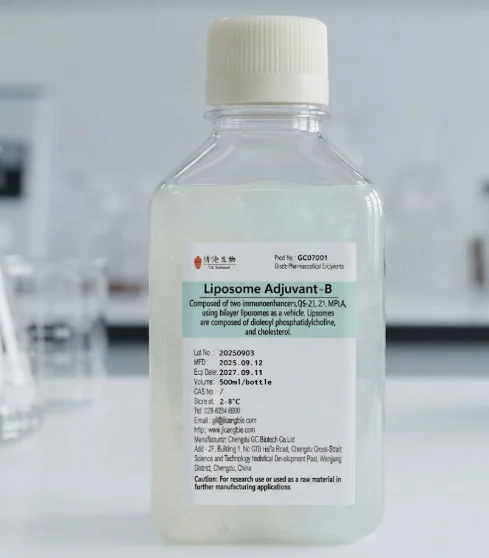
GC Biotech provides a range of life science solutions for research and development. One of its products, Liposome Di-Adjuvant B, is designed as a dual-component liposomal adjuvant containing 3D-MPLA and QS-21.
What Makes Liposome Di-Adjuvant B Different?
A single adjuvant component may activate only certain parts of the immune system. Combining different immunostimulatory mechanisms can provide researchers with a broader approach when developing vaccine formulations.
Liposome Di-Adjuvant B uses two important components:
- 3D-MPLA (3-O-desacyl-4'-monophosphoryl lipid A): A TLR4 agonist that can stimulate innate immune signaling and promote cytokine production.
- QS-21: A saponin-based adjuvant widely studied for its ability to support both cellular and antibody-mediated immune responses.
These components are incorporated into a liposomal structure. The lipid bilayer provides a carrier system that can help bring the two components together and support their delivery in vaccine research formulations.
This combination makes Liposome Di-Adjuvant B an interesting option for researchers studying adjuvant-antigen interactions and immune activation.
How Does a Liposome Adjuvant Support Immune Activation?
After administration, an adjuvant does more than simply stay at the injection site. It can influence the local immune environment and affect how immune cells respond to the antigen.
One important area of interest is the interaction between the adjuvant and innate immune cells.
Supporting the Local Immune Environment
The initial immune response begins around the administration site. Immunostimulatory signals can influence local cells and promote the release of cytokines and other signaling molecules.
These signals may help create an environment in which immune cells, including monocytes and neutrophils, are recruited to the area.
Involvement of Antigen-Presenting Cells
Monocytes and other innate immune cells can participate in the development of antigen-presenting cell populations. Dendritic cells are particularly important because they help connect the early innate immune response with the later adaptive immune response.
For vaccine researchers, improving the interaction between antigens, adjuvants, and dendritic cells is therefore an important part of formulation development.
Supporting Antigen Presentation
Once an antigen is taken up and processed by antigen-presenting cells, the resulting signals can contribute to T-cell and B-cell activation.
A well-designed vaccine adjuvant can therefore support several stages of this process, from local immune stimulation to antigen processing and presentation in draining lymphoid tissues.
Liposome-based systems are especially interesting because they provide a delivery structure for immunostimulatory components while allowing researchers to investigate how formulation characteristics influence immune responses.
Why Liposomal Delivery Matters in Vaccine Formulation
Vaccine formulation can be challenging when purified proteins, recombinant antigens, or other complex biological materials are involved. Some antigens may have limited immunogenicity or may not interact efficiently with immune cells on their own.
A liposomal adjuvant system can provide several formulation advantages for research.
Consistent Particle Characteristics
The physical characteristics of liposomes, including their size and composition, can affect their behavior in a formulation. Controlled and reproducible liposome preparation is therefore important when researchers compare different experimental groups.
Liposome Di-Adjuvant B is based on bilayer liposomes with a controlled particle size range, providing a defined platform for vaccine adjuvant research.
Combining Multiple Components
Using 3D-MPLA and QS-21 together allows researchers to investigate the effects of two different immunostimulatory components within one formulation.
This can be useful when studying how innate immune signaling, antigen uptake, and adaptive immune responses interact.
Application in Subunit Vaccine Research
Subunit vaccines often contain selected antigen components rather than complete pathogens. Although this approach offers important development advantages, these antigens may require additional immune stimulation.
A specialized liposome adjuvant for subunit vaccines can therefore be considered during formulation screening and preclinical studies.
Researchers can evaluate different antigen-adjuvant combinations to determine which formulation provides the most appropriate immune response for their specific research model.
Applications in Preclinical Vaccine Studies
Adjuvant research is relevant to many areas of modern life science research. Liposome Di-Adjuvant B can be considered in studies involving vaccine formulation, infectious disease research, and other projects where controlled immune stimulation is required.
For laboratories, reproducibility is particularly important. Differences in reagent quality, formulation characteristics, or preparation methods can make it difficult to compare experimental results.
Working with a defined vaccine adjuvant platform can help researchers establish more consistent experimental conditions and better understand the relationship between formulation design and immune response.
Choosing an Adjuvant for Vaccine Development
There is no single adjuvant that is suitable for every vaccine project. Researchers normally need to consider the antigen type, desired immune response, formulation compatibility, delivery system, experimental model, and development stage.
For this reason, the value of an adjuvant is not simply determined by how strong it is. Its compatibility with the overall vaccine formulation is equally important.
A dual-component system such as Liposome Di-Adjuvant B provides researchers with another option for investigating combined immune stimulation through 3D-MPLA and QS-21.
Conclusion
Modern vaccine development increasingly depends on more than antigen selection. The choice of adjuvant and delivery system can also influence how effectively an antigen interacts with the immune system.
By combining 3D-MPLA and QS-21 in a liposomal delivery system, Liposome Di-Adjuvant B offers researchers a practical platform for studying immune activation, antigen presentation, and vaccine formulation.
For laboratories working on subunit vaccines, infectious disease research, or advanced immunology studies, exploring a suitable liposome adjuvant can be an important part of developing and optimizing future vaccine candidates.