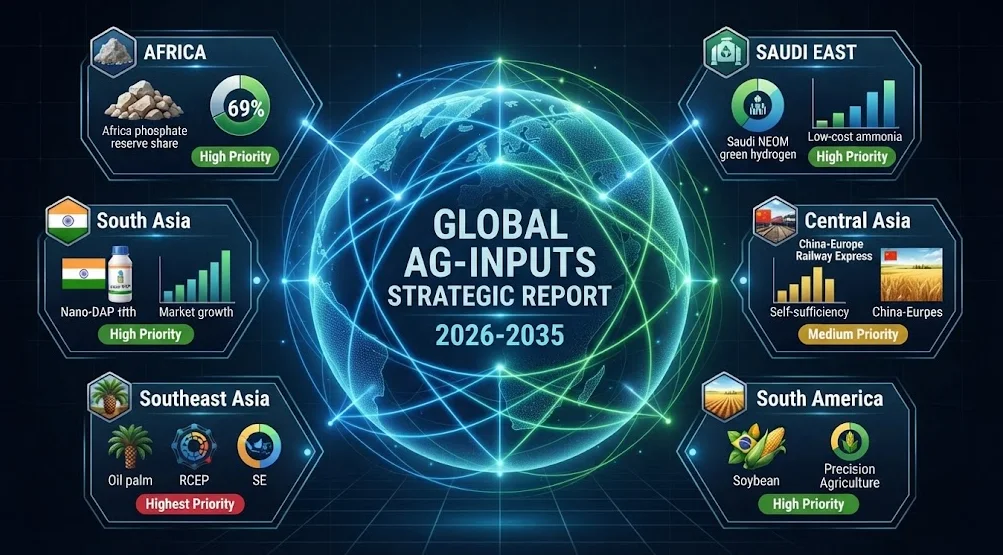
The global agricultural input industry is entering a period of structural change. Fertilizer supply security, food production, resource availability, green manufacturing, and local production policies are becoming increasingly important for companies looking at overseas expansion.
Among the many markets available to investors, six regions deserve particular attention: Africa, South Asia, Southeast Asia, the Middle East, Central Asia, and South America. Their market conditions are very different. Some have abundant phosphate resources, while others depend heavily on imports. Some are suitable for large integrated fertilizer projects, while others are better suited to trading, blending, formulation, or agricultural services.
This article reviews the development of the agricultural chemical and phosphate/compound fertilizer industries in these six regions and highlights the most practical investment opportunities.
1. Africa: Strong Resources and Huge Fertilizer Demand
Africa has one of the strongest long-term fertilizer stories in the world. The continent combines enormous agricultural potential with relatively low fertilizer use, while North Africa has some of the world's most important phosphate resources.
Phosphate and Compound Fertilizers
Morocco, including Western Sahara, holds approximately 69% of known global phosphate rock reserves, according to USGS 2026 data. This gives the country a major position in the global phosphate industry.
OCP Group remains the dominant player. Its phosphate fertilizer production capacity increased from around 3 million tons per year in 2008 to approximately 16 million tons in 2025, with plans to reach 19 million tons by 2027.
OCP is also moving beyond traditional phosphate fertilizer production. Its projects increasingly combine phosphate resources, fertilizer manufacturing, renewable energy, and green ammonia. The company has expanded cooperation with international partners, including Koch Ag & Energy Solutions, while continuing to invest in large industrial and green-energy projects.
The situation is very different in Sub-Saharan Africa. Around 80% of fertilizers are still imported, creating opportunities for local blending, repackaging, distribution, and fertilizer manufacturing. The African fertilizer market is expected to continue expanding strongly through the next decade.
Agricultural Chemicals
Pesticide use remains relatively low across much of Africa. However, commercial crops such as cocoa, coffee, cotton, and oil palm create stable demand for herbicides and fungicides.
Bio-pesticides are another emerging area because local production remains limited and many products are imported.
Investment Outlook
Large companies can consider integrated phosphate and fertilizer projects in Morocco and Egypt, while medium-sized companies may find better opportunities in fertilizer blending, agrochemical formulation, water-soluble fertilizers, and bio-activated phosphorus products in countries such as Nigeria, Tanzania, and Kenya.
For smaller companies, regional distribution combined with soil testing and fertilizer advisory services can provide a lower-risk entry model.
The main risks are political instability, currency depreciation, credit problems, and restrictions on foreign ownership of strategic mineral resources.
2. South Asia: India Leads a Large Import-Driven Market
South Asia has a very different market structure. India has enormous agricultural demand but limited domestic phosphate resources, making imported phosphate raw materials and finished fertilizers extremely important.
Phosphate Fertilizers
India is one of the world's largest DAP importers. Its phosphate fertilizer market was estimated at around USD 4.25 billion in 2025 and is expected to reach approximately USD 5.52 billion by 2031.
Government fertilizer subsidies play an important role. For the 2026 Kharif season, India approved approximately INR 415.338 billion in subsidies for phosphate and potash fertilizers.
The subsidy system helps maintain the availability of DAP, NPKS, and other important fertilizers for farmers. At the same time, rising international raw material and transportation costs can increase government subsidy pressure.
India's domestic companies, including IFFCO and Coromandel, remain important players in fertilizer production and distribution. Nano-liquid DAP and other higher-value fertilizer products are also attracting increasing attention.
Agricultural Chemicals
India is also a major pesticide market, particularly for rice, wheat, cotton, fruits, and vegetables. Herbicides account for a large share of demand.
Bio-pesticides are growing even faster. The Indian bio-pesticide market is expected to expand significantly over the coming years as farmers and regulators pay more attention to sustainable agricultural inputs.
Investment Outlook
For medium-sized fertilizer companies, phosphoric acid processing, water-soluble phosphate fertilizers, specialty fertilizers, and bio-based fertilizer products are attractive areas.
Port-based warehousing and repackaging can also support fertilizer distribution to India and neighboring markets such as Bangladesh and Nepal.
However, large-scale phosphate mining is less attractive because India has limited high-quality phosphate rock resources. Traditional DAP projects can also face margin pressure because of government price controls and intense competition.
3. Southeast Asia: A Growing Market for Local Production and Specialty Fertilizers
Indonesia, Vietnam, Thailand, Malaysia, and the Philippines form one of the most attractive agricultural input markets in Asia.
The region is a major producer of rice, palm oil, rubber, fruits, and vegetables, which creates stable demand for both fertilizers and crop protection products.
Fertilizer Market
Southeast Asia remains dependent on imported fertilizer raw materials and finished products. Malaysia, for example, consumes more than 4 million tons of fertilizer annually, while more than 70% is imported.
Vietnam and Indonesia already have some phosphoric acid and DAP production capacity, but other markets remain highly dependent on imports.
Chinese fertilizer suppliers have an important position in the region because of competitive pricing, manufacturing capacity, logistics, and regional trade relationships.
Agricultural Chemicals
Rice and oil palm are major drivers of herbicide and fungicide demand. Multinational companies such as Syngenta, ADAMA, and UPL have established strong distribution networks.
At the same time, specialty fertilizer products are gaining attention. Liquid water-soluble phosphorus, slow-release fertilizers, concentrated formulations, and products designed for drone spraying are potential growth areas.
Investment Outlook
Vietnam and Indonesia are particularly suitable for compound fertilizer blending, water-soluble phosphate production, and agrochemical formulation.
Malaysia and Thailand can also serve as useful warehousing and distribution locations because of their ports and established agricultural markets.
Companies should still pay close attention to local product registration, environmental requirements, investment approval, and differences between individual ASEAN markets.
4. Middle East: Resource Advantages Support Large Phosphate Projects
The Middle East has two major advantages for the fertilizer industry: phosphate resources and relatively low-cost energy.
Saudi Arabia, Egypt, and Jordan are particularly important for phosphate-related investment.
Phosphate and Compound Fertilizers
Saudi Arabia's Maaden is one of the region's leading phosphate fertilizer producers. Its phosphate fertilizer capacity reached approximately 6 million tons per year in 2025.
The company's Phosphate 3 project is expected to add significant capacity. Phase I is planned for commissioning in 2027, while the complete project is expected to add approximately 3 million tons of phosphate fertilizer capacity.
Egypt also has substantial phosphate rock reserves, estimated at around 3 billion tons. Its location around the Suez Canal provides an additional logistics advantage for serving European, Asian, and African markets.
The region is therefore well positioned for phosphate rock processing, phosphoric acid, DAP/MAP, and high-value phosphate chemicals.
Agricultural Chemicals
Local agricultural land is limited, so pesticide demand is much smaller than in South America or South Asia. However, greenhouse farming, irrigation agriculture, fruit and vegetable production, and protected cultivation create demand for high-efficiency fertilizers and selected crop protection products.
Green Fertilizer Opportunities
Green ammonia is becoming an important part of the region's future fertilizer strategy. Saudi Arabia's large renewable-energy and green-hydrogen projects could eventually support lower-carbon fertilizer production.
Investment Outlook
Large enterprises can consider integrated projects in Egypt, Saudi Arabia, and Jordan.
Smaller specialty fertilizer companies may focus on water-soluble phosphorus, high-purity phosphoric acid, specialty phosphate chemicals, and green-fertilizer technologies.
The major risks are geopolitical tensions, shipping disruptions, mineral resource controls, and dependence on key transportation routes.
5. Central Asia: A Smaller but Strategically Important Market
Central Asia is different from the coastal fertilizer markets because Kazakhstan, Uzbekistan, Kyrgyzstan, and Turkmenistan are largely landlocked.
Kazakhstan is the region's largest phosphate fertilizer market, accounting for approximately 81% of regional phosphate consumption. Uzbekistan is also an important import market.
Fertilizer and Agrochemical Demand
Traditional granular DAP and compound fertilizers still dominate the market. However, specialty fertilizer penetration remains low, creating room for slow-release phosphate fertilizers, water-soluble products, and crop-specific formulations.
Wheat, cotton, corn, and other large-scale field crops generate stable demand for herbicides and fertilizers. More than 90% of agrochemicals are imported from Russia and China.
Resource and Logistics Conditions
Central Asia does not have the same level of commercially attractive phosphate resources as Morocco or Saudi Arabia. Fertilizer raw materials therefore depend heavily on external supply.
However, the region has an important logistical advantage: its connection with China through land transportation and the China-Europe Railway network.
Investment Outlook
For most companies, large integrated phosphate projects are not the best starting point.
More practical opportunities include:
- Compound fertilizer blending in Kazakhstan and Uzbekistan
- DAP and ammonium phosphate repackaging
- Slow-release fertilizers for wheat and cotton
- Agrochemical distribution warehouses
- Soil testing and crop protection services
- Biostimulants for fruit, vegetable, and cash crops
Because the region is landlocked, transportation costs and border policies should be carefully considered before making a large investment.
6. South America: Brazil Favors High-Value Agricultural Inputs
Brazil is one of the world's most important agricultural economies and the largest fertilizer market in South America.
Its huge soybean, corn, sugarcane, and other crop sectors create strong demand for fertilizers, herbicides, fungicides, and agricultural technologies.
Phosphate Fertilizer Market
Brazil's DAP market is estimated at around 3.8–4.2 million tons in 2026. At the same time, fertilizer imports weakened during the first half of 2026, with several major fertilizer and raw material categories recording year-on-year declines.
This does not mean the Brazilian market is losing its long-term attractiveness. Instead, it highlights the importance of product positioning.
Brazil's specialty fertilizer market continues to expand. The market was estimated at approximately USD 1.89 billion in 2025 and is expected to reach around USD 2.68 billion by 2031.
Slow-release fertilizers, water-soluble phosphorus, biological fertilizers, and crop-specific products therefore offer better growth potential than competing only in the basic bulk DAP market.
Agricultural Chemicals
Brazil has a highly developed commercial farming sector. Herbicides and fungicides are widely used in soybean and corn production, while precision agriculture, UAV spraying, biological products, and microbial inoculants are also developing rapidly.
Investment Outlook
Companies entering Brazil should focus on specialty fertilizers, slow-release phosphate products, liquid water-soluble phosphorus, biological inputs, and integrated crop services.
Port-based distribution centers can also help companies manage imported fertilizer and raw materials.
The main challenges include strict product registration, exchange-rate fluctuations, long agricultural credit cycles, and changing trade policies.
Comparing the Six Regional Markets
The six regions do not offer the same type of investment opportunity.
North Africa and the Middle East are mainly resource-driven markets. Their strongest advantage is the combination of phosphate rock, energy, industrial infrastructure, and export access. Large integrated phosphate fertilizer projects are therefore the most logical strategy.
Sub-Saharan Africa, India, and Southeast Asia are more consumption-driven. Fertilizer demand is growing while domestic production remains insufficient in many countries. These markets are more suitable for medium-sized companies involved in blending, formulation, repackaging, distribution, and agricultural services.
Brazil and other South American markets are more mature and competitive. Instead of competing directly in low-value bulk fertilizers, companies can focus on specialty phosphate fertilizers, slow-release products, water-soluble fertilizers, biological products, and precision agriculture services.
Central Asia is better suited to asset-light business models because of its smaller market size and landlocked geography.
Long-Term Opportunities in the Global Fertilizer Industry
Several opportunities appear across almost all six regions.
First, bio-activated phosphorus and biological agricultural inputs are likely to become increasingly important as farmers look for better nutrient efficiency and more sustainable production methods.
Second, slow-release and water-soluble phosphate fertilizers can provide higher value than conventional bulk DAP, particularly in regions with intensive agriculture, protected cultivation, or limited water resources.
Third, local fertilizer processing will continue to expand as governments try to reduce dependence on imported finished products and improve food security.
Finally, fertilizer companies are increasingly moving toward integrated agricultural services, combining fertilizer supply with soil testing, crop recommendations, crop protection, logistics, and technical support.
The global fertilizer industry is therefore not simply expanding in volume. It is also becoming more localized, specialized, and technology-driven.
For investors, the key is to match the business model with the regional conditions: resource-based integrated production for phosphate-rich countries, local blending and formulation for import-dependent markets, and specialty fertilizers and agricultural services for mature agricultural economies.
https://www.phosphoruschemical.com/comprehensive-analysis-report-on-the-agricultural-chemical-and-phosphate-compound-fertilizer-industries.html