In industrial manufacturing, achieving a uniform mixture is essential for maintaining product quality and production efficiency. Whether a factory produces architectural coatings, printing inks, adhesives, pigment pastes, or specialty chemicals, poor dispersion can lead to color variations, inconsistent viscosity, material settling, and additional processing costs.
Choosing the right mixing equipment is therefore an important part of process optimization. A high speed dissolver mixer is widely used to incorporate powders and other solid ingredients into liquid formulations, helping manufacturers achieve more uniform mixtures and improve batch-to-batch consistency.
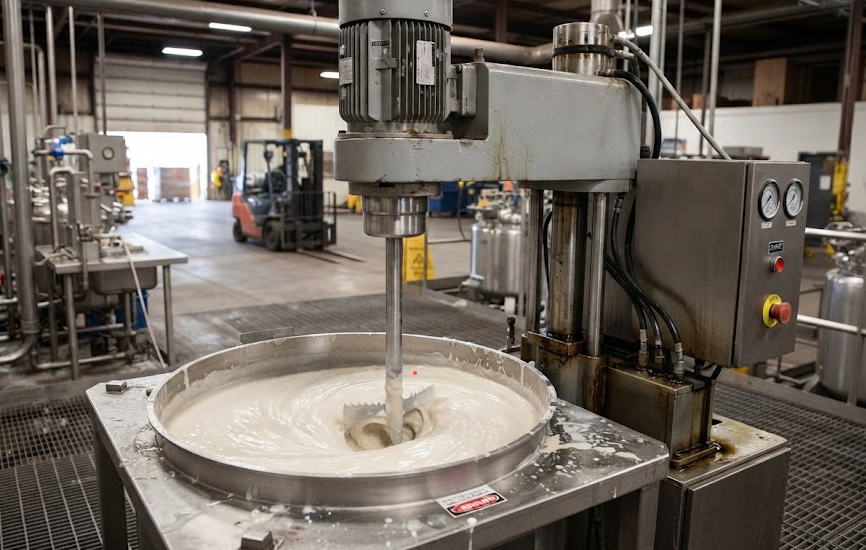
How Does a High Speed Dissolver Mixer Work?
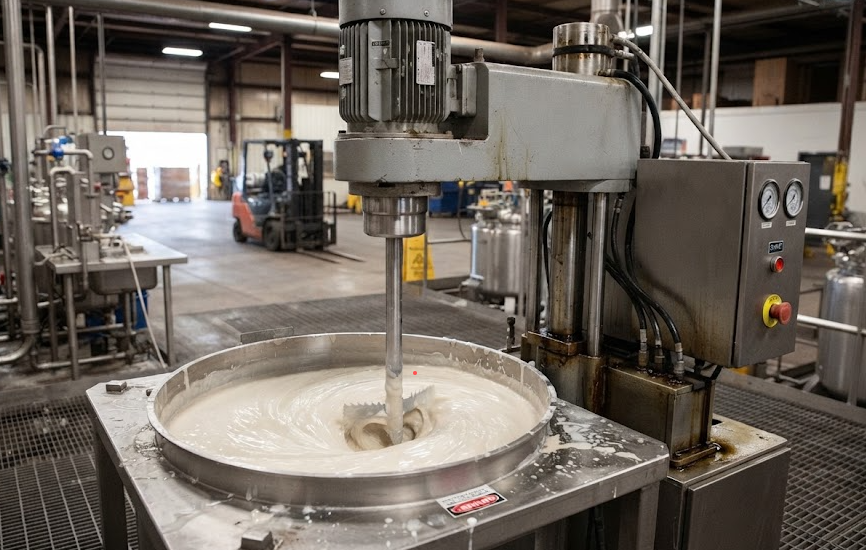
A high speed dissolver mixer uses a rapidly rotating dispersing disc to generate strong fluid movement inside a mixing vessel. This movement helps draw materials into the mixing zone, break apart agglomerates, and distribute solid particles throughout the liquid phase.
The equipment is particularly useful when powders, pigments, fillers, and other ingredients need to be incorporated efficiently. However, mixing performance depends on more than rotational speed alone. Disc design, tank geometry, material viscosity, powder addition rate, and operating conditions all influence the final result.
For manufacturers processing different formulations, adjustable operating speed can provide greater flexibility. Lower speeds may be appropriate during initial powder addition, while higher speeds can support more intensive dispersion when the formulation and equipment permit.
Where Is Industrial High-Speed Dispersion Used?
Paint and coating manufacturing
Paint formulations often contain pigments, fillers, resins, solvents, and additives. If these ingredients are not distributed properly, the finished coating may show uneven color, poor appearance, or inconsistent application properties. A suitable high-speed disperser helps manufacturers prepare a more uniform premix before subsequent grinding or finishing stages.
Printing ink production
Ink manufacturers need consistent pigment distribution to support color uniformity and reliable printing performance. A high speed dissolver mixer can assist with initial mixing and pigment incorporation, although some formulations require additional milling to achieve the required fineness.
Adhesives and sealants
Adhesive formulations may contain polymers, fillers, powders, and functional additives. The appropriate mixing process helps distribute these ingredients while maintaining the required viscosity and material properties. Equipment selection should account for the formulation's flow behavior and sensitivity to heat or shear.
Pigment pastes and specialty chemicals
Pigment concentrates, PVC pastes, dyes, and other chemical formulations can have very different processing requirements. A machine suitable for a low-viscosity liquid may not perform equally well with a heavily loaded or high-viscosity mixture. Matching the equipment to the material is essential for reliable operation.
Five Factors to Consider Before Buying a High Speed Dissolver Mixer Machine
Selecting a high speed dissolver mixer machine based solely on motor power or maximum speed can lead to unnecessary costs or unsatisfactory results. Manufacturers should evaluate the complete production process.
- Material characteristics: Determine the viscosity range, solid content, powder properties, and dispersion requirements of the formulation.
- Working capacity: Select a machine that accommodates the normal batch size and mixing vessel dimensions. Laboratory trials and full-scale production may require substantially different configurations.
- Speed adjustment: Variable-speed control allows operators to adapt mixing conditions to different ingredients and processing stages.
- Temperature and process control: Some materials are sensitive to heat or require controlled processing conditions. Depending on the application, temperature monitoring or control may be necessary.
- Cleaning and maintenance: Accessible components, appropriate wetted materials, and practical cleaning procedures can help reduce changeover time and minimize cross-contamination between batches.
Future production demand should also be considered. A machine that meets today's requirements may not be the most economical choice if the formulation range or batch volume is expected to expand.
Equipment Configuration: Why One Setup Does Not Fit Every Factory
Different production environments may require different equipment configurations. Depending on the material and process, options can include alternative tank materials, vacuum operation, double dispersing discs, temperature control, wall scrapers, and automatic control systems.
These features should be selected according to a defined process need rather than added automatically. For example, vacuum operation may be useful when air entrainment is a concern, while wall scrapers can support material movement in certain vessel configurations. Their suitability depends on the formulation, equipment design, and operating conditions.
It is also important to distinguish dispersion from fine grinding. A high-speed dissolver is often used for mixing and preliminary dispersion, whereas bead mills or other grinding equipment may be needed when a formulation requires tighter particle-size control. Understanding this distinction helps manufacturers build a more effective production line.
Rucca's Solutions for Industrial Mixing and Dispersion
Rucca supplies wet-processing equipment for industries including paints, coatings, printing inks, pigments, dyes, pesticides, and other chemical products. Its product portfolio includes high-speed dispersers, bead mills, basket mills, high-shear mixers, and related processing equipment.
For businesses evaluating an industrial high speed dissolver mixer, Rucca offers equipment options that can be assessed against material characteristics, batch capacity, and production objectives. Depending on project requirements, equipment selection and process support can help customers determine a suitable configuration, while installation, commissioning, operator training, and after-sales services may be available for applicable projects.
Before placing an order, manufacturers should discuss their actual formulation, expected output, target dispersion quality, and operating environment with the supplier. Testing representative materials, where possible, provides a stronger basis for equipment selection than relying on specifications alone.
Conclusion
A high speed dissolver mixer is an important processing tool for manufacturers that need efficient mixing and reliable dispersion of powders, pigments, fillers, and other ingredients. Its performance depends on choosing the right machine configuration and establishing operating conditions suited to the formulation.
By evaluating material properties, batch capacity, process requirements, and future production plans, manufacturers can make more informed equipment decisions. Rucca's range of mixing and dispersion equipment provides options for businesses seeking to improve industrial processing and maintain consistent product quality.
https://www.ruccagroup.net/high-speed-dissolver-mixer-types-applications-and-selection-guide.html