
Maintaining stable quality in lead-acid battery production requires more than checking terminal voltage or examining the battery exterior. The reliability of internal electrical connections is another important consideration, particularly after inter-cell welding. Poor or inconsistent welds may lead to abnormal resistance readings and indicate potential quality issues that need further investigation.
For manufacturers producing automotive starter batteries, motorcycle batteries, and valve-regulated lead-acid (VRLA) batteries, a battery internal resistance tester provides a practical way to identify unusual electrical readings during production. By introducing resistance testing into the quality-control process, manufacturers can identify products that require retesting or additional inspection before moving to the next production stage.
When selecting an automatic testing machine, however, buyers should consider more than the initial purchase price. Testing efficiency, battery size compatibility, automation features, and integration with existing production equipment all affect the machine's long-term value.
Why Test Internal Resistance After Inter-Cell Welding?
Inter-cell welding establishes electrical connections between individual cells inside a lead-acid battery. If a connection is inconsistent, it may contribute to increased resistance or other electrical abnormalities.
A dedicated resistance testing process helps manufacturers evaluate these connections using measurable results rather than relying solely on visual inspection. When readings fall outside predefined limits, operators can investigate the relevant welding points and determine whether further checks are necessary.
It is important to recognize that internal resistance is only one indicator of battery condition. It cannot independently establish overall battery quality or guarantee service life. Depending on the battery design and production requirements, manufacturers should combine resistance measurements with other quality checks, including voltage, capacity, and sealing tests.
What Features Matter in an Automatic Battery Internal Resistance Tester?
Manual testing can work for smaller production operations, but repeated measurements may increase labor requirements and introduce inconsistencies in battery handling. An automatic battery internal resistance testing machine helps standardize the testing sequence and reduce repetitive manual tasks.
When comparing equipment, manufacturers should pay particular attention to the following features.
Stable battery positioning and electrical contact
Accurate measurements depend partly on reliable contact between the testing mechanism and the battery terminals. A consistent positioning process helps reduce measurement variation caused by handling differences or unstable contact.
Configurable testing parameters
Battery manufacturers may produce multiple models with different dimensions and welding requirements. Testing equipment should support suitable parameter settings for each product, with acceptance limits established and validated before production use.
Straightforward identification of abnormal results
Operators need a clear way to recognize readings that exceed the permitted range. A defined response procedure should then guide retesting, contact checks, weld inspection, or product isolation.
These functions help make resistance testing a more repeatable part of the manufacturing process.
Exploring the NST-IT1 from Nexa Battery Technology
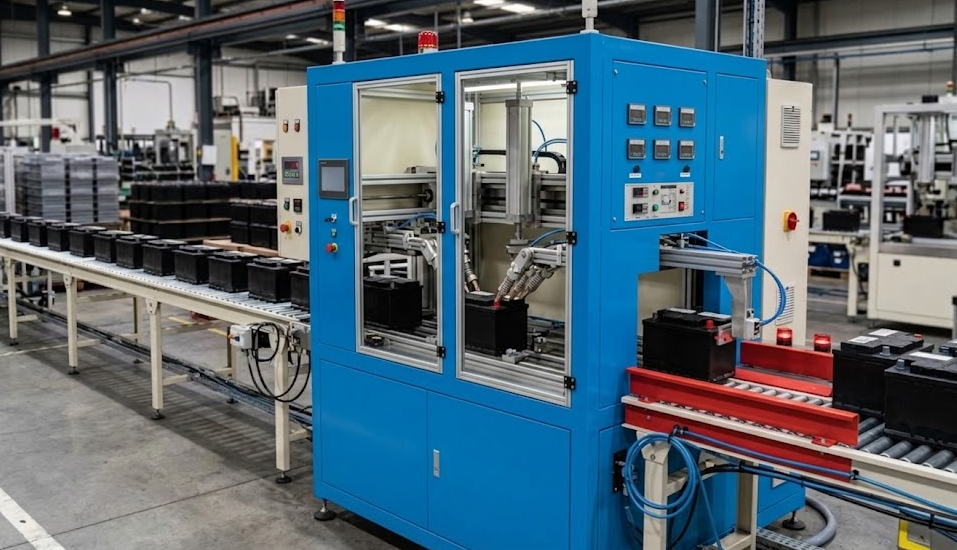
Nexa Battery Technology offers the NST-IT1 automatic internal resistance test machine, designed to inspect inter-cell welding quality at the side poles of lead-acid batteries.
According to the manufacturer's published information, the equipment automates several production steps, including loading, positioning, testing, removal, and unloading. It uses a pulse high-voltage testing method and indicates resistance results that do not meet the configured requirements.
The machine also supports preset battery parameters for different welding requirements. For manufacturers handling multiple battery specifications, this capability can simplify product changeovers when the appropriate settings have been established for each model.
Its listed applications include automotive starter batteries, motorcycle starter batteries, UPS power supplies, and electric bicycles.
For production facilities seeking to reduce manual handling and establish a more consistent inspection process after welding, the NST-IT1 provides an automated option worth evaluating.
Review Production Capacity and Battery Dimensions
An automatic testing machine should match the actual requirements of the production line. If its throughput is too low, testing may become a bottleneck. On the other hand, purchasing equipment with substantially more capacity than necessary may increase investment without providing sufficient operational benefits.
The manufacturer's published specifications for the Nexa Battery Technology NST-IT1 are summarized below.
| Parameter | Published specification |
|---|---|
| Shift capacity | 90–180 pcs/h, based on a 12V/60Ah battery |
| Battery length | 195–527 mm |
| Battery width | 128–240 mm |
| Battery height | 183–240 mm |
| Maximum constant current | 100 A |
| Workstations | One test station and one removal station |
| Conveyor speed | 250 mm/s |
| Power supply | 380 V, 50 Hz, 1 kW |
| Compressed air | 0.5 MPa, 0.05 m³/min |
| Machine dimensions | 2.1 × 1.8 × 2.3 m |
| Machine weight | 850 kg |
The stated throughput is based on a specific battery configuration. Actual output may change according to battery dimensions, handling arrangements, and production-line conditions.
Before purchasing, manufacturers should verify that their battery models fit within the machine's supported dimensional range. Conveyor height, transfer direction, hourly production targets, and connections to upstream and downstream equipment should also be reviewed.
Set Reliable Testing Limits for Different Battery Models
Automated testing can improve process consistency, but it cannot compensate for poorly defined inspection standards.
Resistance measurements may be influenced by battery construction, temperature, battery condition, and the measurement method. For this reason, using identical acceptance thresholds across every battery model may result in inappropriate pass-or-fail decisions.
Manufacturers should establish model-specific limits using engineering requirements, validation tests, and production data. When an abnormal result appears, operators may need to repeat the measurement, inspect terminal contact, examine the relevant weld, or isolate the battery for additional testing.
Routine equipment checks and consistent operating procedures are also important for maintaining dependable results over time.
Plan for Installation and Operating Expenses
The overall cost of an automatic battery internal resistance tester includes more than the equipment purchase price. Installation, utilities, maintenance, staff training, and production-line modifications can all affect the total investment.
For the NST-IT1, buyers should assess available floor space and confirm that the factory can provide the specified electrical supply and compressed air. The machine's published dimensions are 2.1 × 1.8 × 2.3 m, and its weight is 850 kg, so the installation area and equipment handling arrangements need to be considered in advance.
It is also advisable to clarify commissioning services, spare parts availability, routine maintenance, and procedures for changing between battery models. Early planning can help minimize installation problems and interruptions to production.
Final Thoughts
A battery internal resistance tester can help lead-acid battery manufacturers detect abnormal electrical readings and investigate potential inter-cell welding defects. To choose suitable equipment, buyers should evaluate battery compatibility, required throughput, testing standards, factory layout, and long-term operating costs together.
The Nexa Battery Technology NST-IT1 combines automated battery handling, configurable testing parameters, and abnormal-result indication for production inspection. Comparing its published specifications with actual manufacturing requirements is an important step in deciding whether it fits a particular quality-control process.