Drying plays an important role in laboratory testing, component manufacturing, and industrial quality control. However, achieving a reliable result involves more than applying heat. Temperature stability, airflow distribution, drying duration, chamber loading, and operator safety can all influence the outcome.
For laboratories and manufacturers handling different materials or production volumes, selecting the right ZGF-Series Blast Drying Oven means matching equipment performance to the actual application. Shanghai Zhenxin Technology offers this series for users who need controlled heating, forced-air circulation, and flexible chamber configurations.
1. Why Forced-Air Circulation Matters
In a drying oven, heat must reach the material consistently while moisture is removed from the chamber. Without effective air movement, temperature differences may develop between shelves or between the center and edges of a loaded chamber.
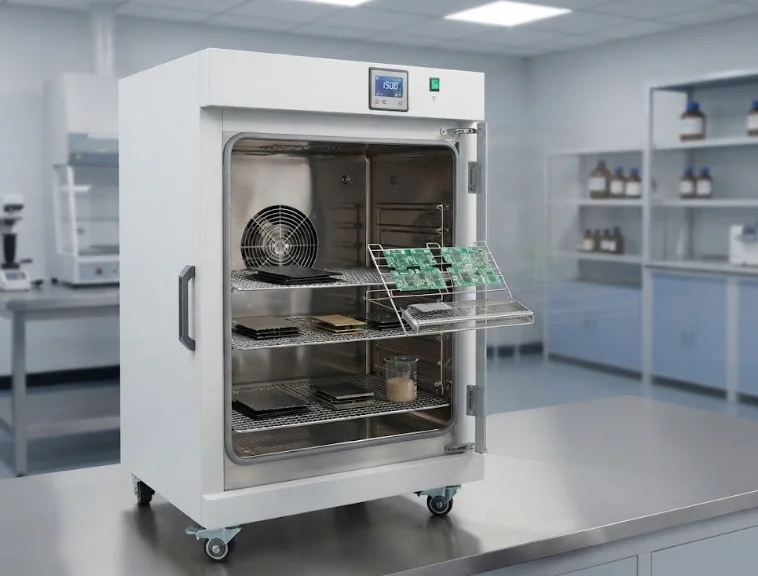
The ZGF-Series Blast Drying Oven uses forced hot-air circulation to distribute heated air throughout the working space. This helps create more consistent drying conditions when processing multiple samples or components in one batch.
Forced circulation can be particularly useful for electronic components, cables, hardware, rubber products, plastic parts, molds, and laboratory samples. Nevertheless, actual drying uniformity depends on the material, load arrangement, airflow paths, and operating conditions. Shelves should be loaded without unnecessarily blocking air circulation.
2. Temperature Control for Repeatable Processes
A high maximum temperature does not automatically make an oven suitable for every application. In many laboratory and production processes, maintaining the correct temperature over time is more important than reaching the highest possible setting.
The ZGF-Series features PID temperature control, with a stated temperature accuracy of ±1°C and a display resolution of 0.1°C. Depending on the selected model, the available temperature range extends to 250°C or 300°C.
Its timer supports settings from 1 to 9999 minutes, with continuous operation also available. These functions allow operators to establish repeatable heating cycles and reduce reliance on manual timing.
For sensitive materials or processes with strict acceptance criteria, users should also verify temperature uniformity under their actual loading conditions. Temperature accuracy and temperature uniformity describe different performance characteristics and should not be treated as interchangeable.
3. Selecting the Right Chamber Capacity
The ZGF-Series includes tabletop and vertical models for different working environments. Smaller tabletop ovens can suit laboratory testing, inspection departments, and low-volume work, while larger vertical configurations offer capacities of up to 1000 L for higher-volume applications.
Choosing chamber capacity requires more than estimating the total volume of the materials being dried. Operators should also consider the dimensions of individual workpieces, the number of samples per batch, shelf spacing, and the airflow clearance needed around each item.
An undersized oven may require frequent batch changes and restrict material placement. An oversized unit, meanwhile, may occupy unnecessary floor space and increase operating costs if its capacity is rarely used.
Matching the chamber to normal workloads—not just occasional peak demand—can help improve equipment utilization.
4. Practical Design and Operator Safety
Daily usability matters when an oven operates for extended periods. The ZGF-Series incorporates several features intended to support routine operation and monitoring.
- Over-temperature protection: Sound and light alarms help alert operators to abnormal temperature conditions.
- Stainless-steel inner chamber: Provides a practical surface for routine cleaning and maintenance.
- Adjustable shelves: Allow users to accommodate different sample sizes and loading arrangements.
- Double-glazed observation window: Enables visual checks without repeatedly opening the door and disturbing chamber conditions.
These features support more convenient operation, but they do not replace workplace safety procedures. Users should follow the operating manual, observe material-specific temperature limits, and ensure adequate ventilation where the process releases moisture, vapors, or other emissions.
5. A Checklist Before Purchasing a ZGF-Series Blast Drying Oven
Before selecting a model from a blast drying oven manufacturer and supplier, buyers should evaluate the process requirements alongside the equipment specifications.
Temperature requirements: Confirm the required operating temperature and whether the 250°C or 300°C configuration is appropriate for the intended materials.
Working capacity: Estimate typical batch size, shelf requirements, and the space needed for airflow.
Installation conditions: Check the unit's dimensions, available power supply, electrical requirements, and installation environment, particularly for larger vertical models.
Process repeatability: Determine whether the application requires additional temperature mapping, calibration, or documented operating procedures.
Long-term support: Ask about operating documentation, spare parts availability, technical assistance, packaging, and after-sales service.
A clear list of requirements makes it easier to compare models and avoid paying for capacity or features that do not contribute to the intended process.
6. Working with Shanghai Zhenxin Technology
Shanghai Zhenxin Technology provides the ZGF-Series Blast Drying Oven as part of its temperature-control equipment range. For laboratory teams, research organizations, and industrial buyers, discussing the intended application with the supplier can help identify a suitable chamber configuration and temperature range.
When requesting a quotation, provide details such as the material being dried, target temperature, batch dimensions, expected workload, and available installation space. This information helps establish whether the proposed equipment matches the actual process.
Conclusion
Consistent drying depends on the interaction of airflow, temperature control, chamber capacity, loading practices, and operating procedures. A well-selected ZGF-Series Blast Drying Oven can support repeatable heating processes across laboratory and industrial applications when its specifications match the work being performed.
For buyers comparing blast drying oven manufacturers and suppliers, Shanghai Zhenxin Technology is an option to consider. Reviewing operating requirements and practical support together can help businesses select suitable equipment and manage long-term operating costs.
http://www.zinscien.com/zgf-series-blast-drying-oven-manufacturer-and-supplier-a-complete-guide.html