
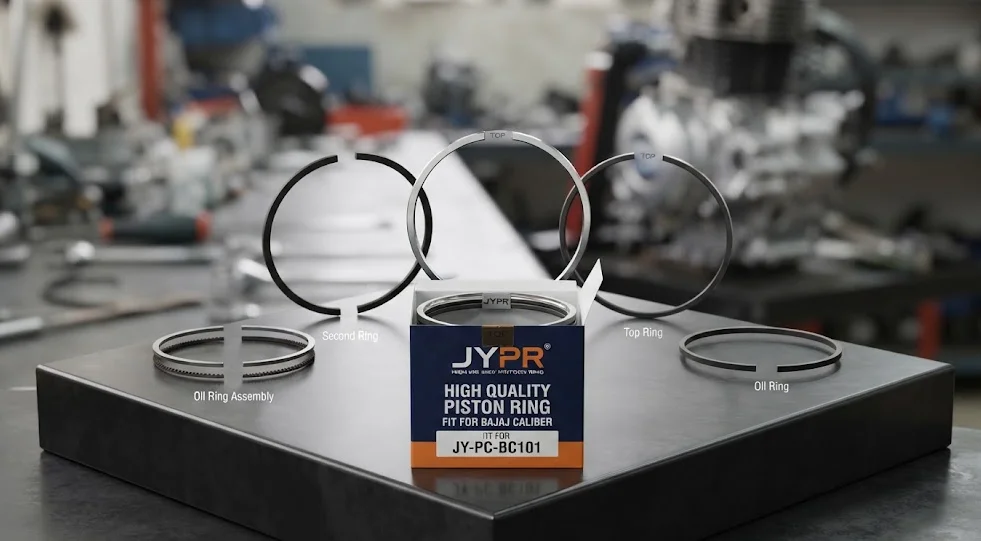
For motorcycle repair professionals and spare parts suppliers, engine reliability depends on the quality and compatibility of every replacement component. Piston rings may be small, but they play an essential role in maintaining compression, regulating engine oil, and supporting consistent engine operation.
On a BAJAJ CALIBER motorcycle, symptoms such as excessive oil consumption, reduced compression, blue exhaust smoke, or declining engine performance may indicate a problem with the piston rings. However, similar symptoms can also result from cylinder wear, valve-related issues, or other engine faults. A proper inspection is therefore necessary before deciding which parts to replace.
When sourcing a high quality Fit for BAJAJ CALIBER Piston Ring, repair shops and parts distributors should pay attention to application compatibility, ring dimensions, material properties, and installation requirements.
Understanding the Role of Piston Rings
Piston rings operate under demanding conditions, including high temperatures, combustion pressure, and continuous friction against the cylinder wall. Their performance affects both engine sealing and lubrication.
Compression rings help limit combustion-gas leakage into the crankcase, supporting the cylinder pressure needed for efficient combustion. The oil control ring regulates the lubricating oil film on the cylinder wall, helping prevent excessive oil from entering the combustion chamber.
As rings wear, lose tension, or become stuck because of carbon deposits, their ability to perform these functions may deteriorate. The result can include increased oil consumption, reduced compression, carbon buildup, and less consistent engine operation.
For motorcycle engine rebuilding, replacing piston rings should therefore involve more than selecting a visually similar component. The replacement must match the engine's specifications and work correctly with the piston and cylinder.
BAJAJ CALIBER Piston Ring Dimensions to Confirm
Dimensional compatibility is one of the most important factors when ordering replacement rings. According to the product information provided by JYPR, the Fit for BAJAJ CALIBER Piston Ring has a listed bore size of 53.00 mm, with the following ring configuration:
| Ring positionListed thickness | |
| First compression ring | 0.8 mm |
| Second compression ring | 0.8 mm |
| Oil control ring | 2.0 mm |
These figures provide a useful reference when identifying the intended application. However, buyers should confirm the exact engine version, piston groove dimensions, and any required oversize before placing an order. The listed bore size alone does not establish compatibility with every piston or cylinder condition.
Incorrect ring thickness or unsuitable groove clearance can cause fitting difficulties and affect ring movement. Ring end gap is equally important: excessive clearance may compromise sealing, while insufficient clearance can cause the ring ends to meet as the engine heats up, potentially damaging the ring or cylinder.
For distributors handling multiple motorcycle applications, checking part numbers and technical specifications before purchasing helps reduce incorrect orders and avoidable returns.
Compression Sealing and Oil Control Must Work Together
A reliable piston ring set needs to balance gas sealing with effective lubrication. These functions are closely related, but they are not interchangeable.
Compression rings help retain combustion pressure, while the oil control ring manages excess lubricant on the cylinder wall. If either function is compromised, engine performance and oil consumption may be affected.
JYPR lists the BAJAJ CALIBER application with a set comprising the first compression ring, second compression ring, and oil control ring. Its broader piston ring product range includes manufacturing options such as alloy cast iron and alloy steel, as well as surface treatments including chrome plating and phosphating, with nitriding available as an option for applicable products.
The appropriate material and treatment depend on the specific ring design and operating requirements. Buyers should verify the available configuration for their intended application rather than assume every material or treatment is offered for every part number.
What to Check Before Buying Replacement Rings
For motorcycle workshops, engine rebuilders, and wholesale buyers, a few checks can make the purchasing process more reliable.
Confirm the exact application. Identify the motorcycle model, engine version, and existing piston specifications. Similar-looking rings should not be treated as interchangeable without technical confirmation.
Inspect the piston and cylinder. Measure cylinder wear and inspect the piston grooves before installing new rings. A new set cannot compensate for a cylinder that is excessively worn or damaged.
Verify installation clearances. Ring end gap and side clearance should meet the applicable service specifications. Ring orientation and installation sequence should also follow the engine manufacturer's instructions.
Consider manufacturing consistency. Stable dimensions, appropriate surface characteristics, and quality inspection are important for repeatable fitting and dependable aftermarket supply.
Plan for repeat orders. Parts distributors should confirm availability, packaging, order quantities, and specification consistency, particularly when supplying repair businesses across different markets.
JYPR as a Piston Ring Supplier
JYPR, operated by Wuxi Jinyang Piston Ring Factory, has been involved in engine component manufacturing and sales since 1998. Its product portfolio includes motorcycle piston rings and components for other engine applications.
For the BAJAJ CALIBER piston ring application, the company describes a production process that includes raw material inspection, precision machining, heat treatment, surface finishing, dimensional measurement, and final inspection. JYPR also supports OEM and customized production based on customer samples, drawings, and technical requirements.
These capabilities may be relevant to international distributors and aftermarket businesses looking for a consistent source of replacement piston rings. Before confirming an order, buyers should provide the engine application, part number or drawing, required quantities, and any specific packaging or customization requirements.
Final Considerations
Successful BAJAJ CALIBER engine repair starts with accurate diagnosis and correct part selection. The listed 53.00 mm bore size and 0.8/0.8/2.0 mm ring configuration offer a useful starting point, but final compatibility should always be confirmed against the actual engine and piston specifications.
For workshops and spare parts distributors looking for a high quality Fit for BAJAJ CALIBER Piston Ring, JYPR offers a product option worth evaluating. Combining verified fitment, correct installation clearances, and careful cylinder inspection helps support reliable engine rebuilding and reduce avoidable repair issues.
https://www.jy-pr.com/how-high-quality-piston-rings-improve-bajaj-caliber-engine-reliability.html