Tunnel construction requires careful coordination between structural design, materials, and installation procedures. Among the many components used in underground infrastructure, fastening hardware plays an important role in connecting precast concrete segments and supporting the integrity of the tunnel lining.
A Tunnel Bolt may look like a small component compared with the overall tunnel structure, but selecting the wrong specification can create installation difficulties or affect connection performance. Bolt geometry, dimensions, material strength, surface protection, and compatibility with the segment design all need to be considered before procurement.
For metro contractors, railway infrastructure projects, precast concrete manufacturers, and engineering distributors, choosing a suitable tunnel segment fastening solution means looking beyond the unit price. The product must meet the project's technical requirements and work effectively with the intended installation method.
1. Why Tunnel Bolts Are Important in Segment Assembly
Many modern tunnels use precast concrete segments to form a continuous lining. During construction, these segments must be aligned and connected according to the engineering design. Their joints may experience loads associated with installation, ground conditions, vibration, and long-term service.
Tunnel bolts help secure the connections between adjoining segments. Their performance depends not only on the bolt itself but also on the complete fastening arrangement, including the nuts, washers where specified, bolt holes, and installation procedure.
This is why a bolt should not be selected by nominal diameter alone. Length, curvature, strength grade, and surface finish must correspond to the design drawings and project specifications.
For railway and metro projects, checking these details before production can help reduce compatibility issues, avoid unnecessary rework, and support a more efficient installation process.
2. Curved Tunnel Bolts for Segment Connections
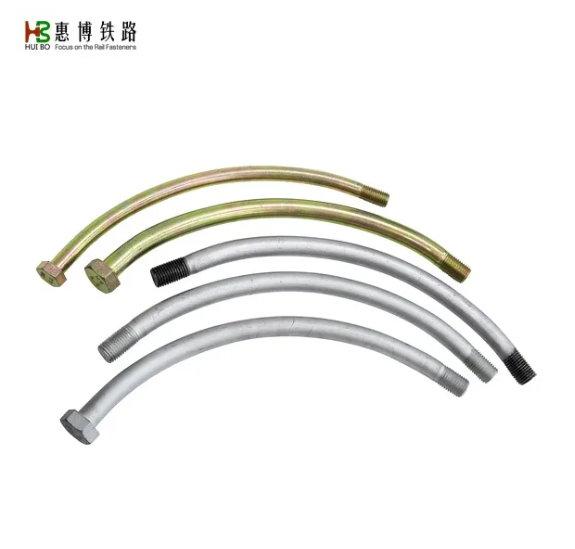
A Curved Tunnel Bolt is designed for applications where the fastening geometry corresponds to curved or radius-shaped holes in tunnel segments. According to HuiBo Railway's product information, its curved tunnel bolts are intended for permanent segment connections and can be used in radial and circumferential joints.
The curvature is an important part of the component's design. The bolt radius must match the intended connection geometry so that the fastener can be installed correctly. Bolt diameter and overall length also need to be considered together with the available space and the segment configuration.
HuiBo Railway offers curved Tunnel Bolt products in sizes ranging from M16 to M30, with lengths and radii available according to customer requirements.
For projects with non-standard segment designs, customized manufacturing can be useful. Providing technical drawings and clearly defined specifications allows the manufacturer to evaluate the required geometry instead of relying on assumptions based on a standard product.
Before placing an order, buyers should confirm the required dimensions, tolerances, material grade, surface treatment, and applicable engineering requirements.
3. Selecting the Appropriate Tunnel Bolt Strength Grade
Strength grade is another important consideration when specifying a high-strength Tunnel Bolt. Different grades have different mechanical properties, and the selected fastener must be suitable for the design loads and connection requirements.
HuiBo Railway lists grade 4.6 mild steel and grade 8.8 high-tensile steel options for its spear bolt and curved tunnel bolt product ranges, with other grades available according to application requirements.
However, a higher strength grade is not automatically the best choice. The appropriate grade depends on the structural design, loading conditions, mating components, and applicable standards. Material properties must also be considered alongside dimensions and installation requirements.
For procurement teams, it is useful to provide the supplier with the following information:
- Required bolt diameter and length
- Curvature or radius requirements, where applicable
- Specified material and strength grade
- Applicable standards and technical drawings
- Required nuts, sockets, or other associated components
This information helps the manufacturer determine whether a standard product is suitable or whether a customized solution needs to be evaluated.
4. Surface Finishes for Underground Environments
Moisture and corrosive conditions can affect the service life of fastening components in underground structures. Selecting a suitable surface treatment is therefore an important part of Tunnel Bolt procurement.
HuiBo Railway identifies galvanized and sherardized finishes as standard options for its curved tunnel bolts, with other finishes available according to customer requirements.
The right finish depends on the project environment and specification. Buyers should consider exposure to moisture, expected service conditions, the required level of corrosion protection, and compatibility with the rest of the fastening assembly.
It is also important to distinguish between a finish being available and its suitability for a particular project. The required coating type, thickness, inspection criteria, and any relevant mechanical or dimensional requirements should be confirmed before production.
For infrastructure projects with long service expectations, these details should be included in the procurement documentation rather than left until installation.
5. Spear Bolts and Sockets for Practical Installation
Curved tunnel bolts are not the only fastening option used for segment connections. HuiBo Railway also supplies Spear Bolts and Sockets for tunnel-related applications.
According to the company's product information, spear bolts are designed to perform a similar segment-fixing function while offering installation advantages. The system is intended to simplify segment erection, with only one pocket per bolt requiring finishing after installation.
Installation considerations can have a significant effect on overall project efficiency, especially on large metro and railway tunnel projects. A fastening system should therefore be evaluated not only by its mechanical specifications but also by the accessibility of the connection, the installation sequence, and the finishing work required.
Before selecting between curved tunnel bolts and spear bolt systems, engineering teams should verify that the chosen arrangement is compatible with the segment design and the project's construction method.
6. What to Check Before Ordering Tunnel Bolts
A clear specification helps reduce procurement errors and makes communication between contractors, designers, and manufacturers more efficient.
When sourcing Tunnel Bolts, buyers should review several key points:
Dimensional compatibility: Confirm the diameter, length, radius, hole geometry, and relevant tolerances against the engineering drawings.
Mechanical requirements: Verify the required material and strength grade based on the design and applicable standards.
Corrosion protection: Specify the required surface finish and inspection criteria for the intended service environment.
Installation requirements: Check whether the fastening arrangement requires particular nuts, sockets, tools, or finishing procedures.
Customization capability: Determine whether the supplier can manufacture non-standard dimensions or configurations based on approved drawings or samples.
Quality documentation: Clarify inspection requirements, material documentation, and any certificates or test reports required by the project.
These checks are particularly important for large orders, where a mismatch between the supplied fastener and the segment design can lead to delays, replacement costs, or installation difficulties.
7. HuiBo Railway's Tunnel Fastening Products
HuiBo Railway is a railway fastening manufacturer based in Changshu, Jiangsu, China. The company reports more than 20 years of production experience and supplies railway and tunnel-related fastening products to domestic and international customers.
Its product range includes track bolts, segment bolts, metro bolts, tunnel bolts, rail clips, rail spikes, and other fastening components. The company also states that customized products can be manufactured according to customer samples or technical drawings.
For buyers sourcing Tunnel Bolts, this range of product options provides a starting point for discussing dimensions, strength grades, surface treatments, and related fittings. The final selection should still be based on confirmed product specifications and the technical requirements of the intended project.
Providing complete drawings and procurement requirements at the beginning of the process can help clarify whether an existing configuration is suitable or whether a customized product is needed.
Conclusion
Choosing the right Tunnel Bolt requires more than matching a nominal size. Curvature, length, mechanical properties, surface treatment, and installation requirements all influence whether a fastening component is suitable for a particular tunnel segment connection.
For metro, railway, and underground infrastructure projects, a clearly defined fastening specification can help improve procurement accuracy and support efficient segment assembly. HuiBo Railway offers curved tunnel bolts, spear bolts, and related fastening products, with customization options for project-specific requirements.
By confirming technical details early and working from approved drawings, project teams can make more informed purchasing decisions and select tunnel fastening components that match their engineering and installation needs.https://www.hbrailwayfastening.com/beyond-the-bolt-how-the-right-tunnel-bolt-supports-reliable-segment-connections.html