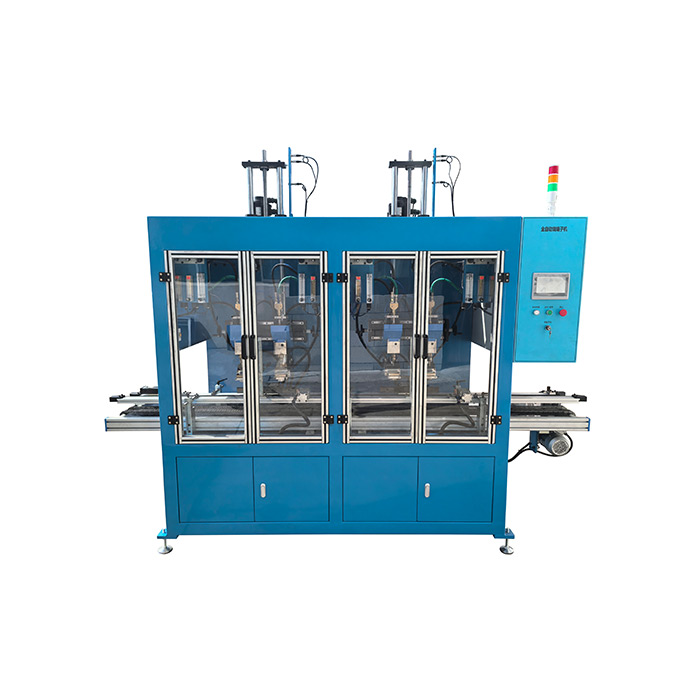
In battery manufacturing, welding and sealing are two processes that have a direct impact on the quality and reliability of the finished battery. A weak weld may affect both the electrical connection and the strength of the joint, while an uneven seal can create leakage risks and affect battery performance during use.
For factories producing batteries in large quantities, maintaining the same quality through manual operations can be challenging. Differences in operator skills, positioning, and working conditions may lead to variations from one battery to another. As a result, more manufacturers are turning to automated battery sealing and welding machines to make these processes more stable and repeatable.
The Role of Welding in Battery Manufacturing
Welding is an essential step in battery assembly because it creates key electrical and mechanical connections.
For example, in lead-acid battery production, inter-cell welding connects individual cells and forms a continuous electrical path. Terminal welding is another important operation because it connects the internal battery structure with the external terminals.
The quality of these connections matters. Problems with positioning, welding conditions, or material handling can result in weak or defective joints.
An automatic inter-cell welding machine can help manufacturers achieve more consistent results by controlling the position of the components and maintaining set operating conditions. This reduces the dependence on manual operation and makes it easier to repeat the same process across a large production batch.
Why Battery Sealing Needs Consistency
Sealing a battery is not simply a matter of closing the housing. The sealing process helps protect the internal components and maintain the required condition of the battery enclosure.
An automatic heat sealing machine provides controlled temperature, pressure, timing, and positioning during the sealing process. This can be particularly useful for high-volume production.
Even a small difference in sealing conditions may become a significant quality issue when it is repeated across hundreds or thousands of batteries. Consistent sealing can therefore help reduce unnecessary rework and improve overall production stability.
Automation also reduces repetitive manual handling, allowing operators to focus more on machine monitoring and quality control.
Automation Brings More Than Faster Production
Production speed is often one of the first reasons manufacturers consider automation, but consistency is just as important.
A modern battery production line may include several connected operations, such as positioning, welding, sealing, epoxy dispensing, material handling, and testing. Automated equipment can help organize these operations into a more standardized sequence.
Nexa Battery Technology provides automated equipment for several important lead-acid battery production processes, including automatic inter-cell welding, heat sealing, terminal welding, cover epoxy dispensing, and battery testing.
By combining these machines within an appropriate production workflow, battery manufacturers can reduce repetitive manual work while maintaining greater consistency between individual batteries.
Testing Is Still an Important Part of the Process
Automation alone does not guarantee a defect-free battery. Welding and sealing processes still need to be supported by appropriate inspection and testing.
Testing equipment can help identify problems that may not be obvious during assembly. For example, short-circuit testing, internal-resistance testing, and air-leakage testing can provide additional checks after different battery production stages.
Nexa Battery Technology also offers equipment for these testing functions. Combining battery welding machines, sealing equipment, and testing systems can give manufacturers a more complete approach to production quality.
Instead of discovering a problem after the finished battery has left the factory, manufacturers can use testing to identify potential issues earlier in the process.
Controlling Variation in High-Volume Production
Large-scale manufacturing naturally creates challenges related to process variation. If the welding position, sealing temperature, terminal connection, or other conditions change from one battery to another, product consistency can be affected.
Automated machines help address this issue by repeating predefined operations under controlled conditions. However, regular maintenance is still necessary.
Fixtures, heating components, sensors, welding parts, and other machine components should be inspected regularly. Machine settings also need to be adjusted when production requirements change.
Material quality is another factor that should not be overlooked. Even a well-designed automatic production system may have difficulty maintaining consistent results if the incoming materials vary significantly.
What to Consider When Choosing Battery Welding and Sealing Equipment
Choosing a battery production machine should involve more than comparing production speed.
Manufacturers should first consider the type and dimensions of the battery, required production capacity, welding requirements, sealing method, level of automation, and compatibility with the existing production line.
Changeover requirements are also worth considering if a factory produces different battery models. Easy adjustment between production specifications can make the equipment more practical for manufacturers with multiple product types.
Testing functions and after-sales support should also be part of the evaluation. A machine is a long-term investment, so maintenance requirements, replacement parts, technical support, and machine reliability all matter.
For a new production line, it is usually better to look at the complete manufacturing process rather than select individual machines separately. Welding, sealing, dispensing, handling, and testing equipment should work together as part of one production system.
Creating a More Reliable Battery Production Process
Battery manufacturing involves many individual operations, and each one can influence the final product. Welding creates important electrical and mechanical connections, while sealing helps protect the battery's internal structure. Testing then provides another opportunity to identify potential problems.
For lead-acid battery manufacturers, automated equipment from Nexa Battery Technology covers several of these important production stages.
A suitable combination of automatic battery sealing machines, battery welding machines, dispensing equipment, and testing systems can help reduce process variation and repetitive manual work. More importantly, it can provide manufacturers with a more consistent and organized production workflow.
As battery production continues to move toward greater automation, reliable welding, sealing, and testing equipment will remain an important part of building efficient and stable manufacturing lines.