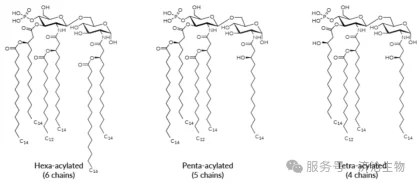
Monophosphoryl lipid A (MPLA) and its derivatives are important components in the development of modern vaccine adjuvants. By interacting with Toll-like receptor 4 (TLR4) signaling pathways, these molecules can help stimulate immune responses while reducing the toxicity associated with bacterial lipopolysaccharide (LPS).
However, not all MPLA-related products are structurally or functionally equivalent. Differences in manufacturing methods, acyl-chain composition, molecular structure, purity, and production scale can influence their suitability for vaccine research and development.
For researchers and vaccine developers evaluating 3D-MPLA, synthetic MPLA, PHAD, and related adjuvant molecules, understanding these differences is essential when selecting raw materials for preclinical studies, formulation development, and potential clinical applications.
This guide compares different manufacturers and production approaches, explains key structural distinctions, and answers common questions about 3D-MPLA products.
1. How Do Different Manufacturers Compare in Synthetic 3D-MPLA?
Chemically synthesized 3D-MPLA products are designed to provide more precisely defined molecular structures. The following comparison summarizes the suppliers and development information described in the source material.
| Manufacturer | Production approach | Reported development status | Main application areas | Production capabilities |
|---|---|---|---|---|
| Avanti Polar Lipids | Fully synthetic 3D-MPLA, including the 3D-PHAD™ series | Reported extensive clinical research use and support for vaccine development | Recombinant protein vaccines, mRNA vaccines, veterinary vaccines, immunology research, and cancer immunotherapy | GMP-grade production with supply ranging from milligram to kilogram quantities |
| Maikang | Fully synthetic 3D-MPLA under GMP-oriented production | Primarily adjuvant raw material supply and early-stage combination-adjuvant research | Shingles vaccines, RSV vaccines, cancer vaccines, and custom adjuvant development | Reported stable 200 g batches and customized production |
| Nanjing Well | Fully synthetic 3D-MPLA | Mainly research materials and small-batch samples, including reported use in early-stage clinical research programs | Preclinical vaccine studies, adjuvant screening, and in vitro immunology experiments | Production capacity not specified in the source material |
| Chongqing Baidaxin | Synthetic 3D-MPLA, including hexa-acylated 4′-monophosphoryl lipid A derivatives | Research and pilot-scale development, with an industrial production base under construction according to the supplied information | Vaccine adjuvant development, cancer vaccines, and emerging vaccine platforms | Production capacity not specified in the source material |
When comparing synthetic 3D-MPLA suppliers, buyers should look beyond the product name. Important factors include molecular identity, acyl-chain composition, purity, batch-to-batch consistency, analytical documentation, and the manufacturer's ability to support the intended research or manufacturing scale.
Clinical experience attributed to a particular molecule or adjuvant formulation should also be distinguished from evidence relating to a supplier's specific product.
2. How Do Fermentation-Derived 3D-MPLA Products Compare?
Fermentation-derived or naturally sourced MPLA products have a different manufacturing history from fully synthetic materials. The source information identifies several suppliers and developers with different roles in research, vaccine development, and commercial production.
| Manufacturer or supplier | Technical route | Reported development status | Main application areas | Supply characteristics |
|---|---|---|---|---|
| GSK / Corixa | Salmonella-derived MPLA processing | Commercial vaccine adjuvant systems have been used in approved vaccines, including Shingrix and Arexvy | Shingles vaccines, RSV vaccines, and other vaccine research areas | Established large-scale commercial supply associated with marketed vaccine products |
| Sigma supplier | Research-grade products described as using Salmonella or E. coli extraction routes | Primarily laboratory research and immunological studies | TLR4 signaling, in vitro immune experiments, and basic scientific research | Global research-material distribution; kilogram-scale availability is reported in the source |
| Recbio | Salmonella-derived MPLA | Mainly associated with its own adjuvant and vaccine development programs | Recombinant shingles vaccines, COVID-19 vaccine research, and related platforms | Primarily for internal development according to the source material |
| Chengdu GC Biotech | Salmonella Minnesota R595 fermentation-derived route, with processing described as aligned with European Pharmacopoeia requirements | Reported support for preclinical vaccine research by pharmaceutical companies | Recombinant protein vaccines, shingles vaccines, RSV vaccines, cancer vaccines, allergy vaccines, and mRNA-compatible platforms | Reported milligram-to-kilogram supply, stable hundreds-of-grams production, and customized manufacturing |
These companies should not be viewed as interchangeable suppliers. Some focus on commercial vaccine products, some mainly serve laboratory research, and others aim to provide adjuvant raw materials and technical support throughout vaccine development.
For procurement decisions, it is important to confirm the exact product grade, source and manufacturing process, release specifications, documentation, and available supply capacity directly with the manufacturer.
3. Can Suppliers Provide an SOP for 3D-MPLA Preparation and Use?
A reliable supplier should provide documentation appropriate to the product grade and intended application. Depending on the material and service package, this may include:
- Product specification and certificate of analysis (COA)
- Safety data sheet (SDS/MSDS)
- Storage, handling, and preparation instructions
- Applicable preparation or formulation SOPs
- Analytical characterization and quality-control information
- Relevant scientific references and technical support
The availability of each document may differ between research-grade and GMP-grade products. Before purchasing, researchers should confirm whether the supplier can provide a preparation SOP suited to the intended formulation, experimental model, and downstream application.
An SOP should be specific to the material and validated process rather than assumed to apply to every MPLA derivative.
4. What Are the Differences Between MPLA, 3D-MPLA, and 3A–7A Derivatives?
The names MPLA and 3D-MPLA describe related but distinct structural categories. The 3A, 4A, 5A, 6A, and 7A labels in the supplied comparison refer to derivatives distinguished by the number of fatty acyl chains.
| Product or derivative | Acyl-chain profile described in the source | Structural characteristics | Research positioning |
|---|---|---|---|
| MPLA | Heterogeneous mixture, generally containing multiple acyl-chain species | Derived from LPS through processing that reduces its phosphate content | Established class of TLR4-targeting adjuvant molecules |
| 3D-MPLA | Mixture of acylated species, with the distribution depending on the production process | Further deacylated at the 3-O position compared with the corresponding MPLA structure | Used in established adjuvant systems and vaccine research |
| 3D-MPLA-3A | Three acyl chains | Further deacylated derivative with a three-chain structure | Used in structure–activity and immune-modulation research |
| 3D-MPLA-4A | Four acyl chains | Four-chain derivative | Used to investigate structure-dependent TLR4 activity |
| 3D-MPLA-5A | Five acyl chains | Five-chain derivative | Used in structure–activity relationship studies |
| 3D-MPLA-6A | Six acyl chains | Six-chain derivative; PHAD-related products are examples of defined synthetic structures | Widely investigated in synthetic adjuvant development |
| 3D-MPLA-7A | Seven acyl chains | More highly acylated structure | Used in comparative structural and immunological research |
Acyl-chain number alone does not fully determine biological activity. Molecular stereochemistry, the position and type of acyl groups, phosphorylation, formulation, and species-specific receptor interactions can also affect activity.
For this reason, claims that a particular derivative is always an agonist, antagonist, or more potent adjuvant should be supported by product-specific experimental evidence. Results from mouse TLR4 assays also should not automatically be extrapolated to human TLR4 responses.
5. Chemical Synthesis Versus Fermentation: What Should Researchers Consider?
The manufacturing route can affect the molecular definition, impurity profile, reproducibility, and scalability of an MPLA-related product.
| Comparison factor | Fermentation or natural extraction | Chemical synthesis |
|---|---|---|
| Molecular composition | May contain a distribution of related acyl-chain species, depending on the process | Can be designed to produce a defined molecular species |
| Batch consistency | Requires control of biological starting materials and downstream processing | Depends on reaction control, purification, and analytical release testing |
| Product characterization | Requires characterization of the composition and distribution of molecular species | Requires confirmation of molecular identity, purity, and relevant impurities |
| Typical use cases | Established adjuvant products and research materials with relevant manufacturing histories | Research requiring defined molecular structures and controlled structure–activity comparisons |
| Scale considerations | Depends on fermentation, extraction, purification, and process yields | Depends on synthesis complexity, purification efficiency, and scale-up validation |
| Regulatory considerations | May benefit from existing product-specific manufacturing and clinical histories | Requires product-specific quality, nonclinical, and clinical evidence appropriate to the intended use |
Fully synthetic materials can offer a more clearly defined molecular composition, which is useful when studying how structural differences affect immune activity. Fermentation-derived materials may offer other advantages, including established manufacturing histories for specific products.
Neither approach automatically guarantees superior quality or regulatory acceptance. The relevant questions are whether the exact material is adequately characterized, whether its manufacturing process is controlled, and whether the available evidence supports the intended application.
Researchers should also avoid assuming that a marketed vaccine's clinical history automatically applies to every product described as MPLA or 3D-MPLA.
6. Are PHAD, 3D-PHAD, 3D-(6-Acyl)-PHAD, MPLA, and 3D-MLA the Same Substance?
These names belong to the same broader family of lipid A-related adjuvant molecules, but they should not be treated as universally interchangeable.
MPLA stands for monophosphoryl lipid A. It refers to a class of lipid A derivatives with a reduced phosphate content compared with the parent LPS structure.
3D-MPLA generally refers to a 3-O-deacylated form of monophosphoryl lipid A. The precise molecular composition depends on the preparation and product.
3D-MLA may be used as an abbreviation for a related 3-O-deacylated monophosphoryl lipid A material. Its exact meaning should be checked against the manufacturer's structural definition.
PHAD and 3D-PHAD are associated with synthetic lipid A-related adjuvant products. The exact structure and acyl-chain composition should be confirmed using the product specification rather than inferred from the name alone.
3D-(6-Acyl)-PHAD identifies a particular defined synthetic derivative. Its similarity to a naturally derived or fermentation-processed material should be assessed through structural characterization and functional testing.
Although these products share structural relationships, differences in acyl-chain number, attachment positions, stereochemistry, and formulation may lead to different biological responses. A product name by itself is not sufficient evidence of chemical identity, equivalence, or comparable safety.
When evaluating alternatives, researchers should request structural diagrams, molecular specifications, purity data, and relevant functional assay results.
7. Can GC Biotech Provide Structural Formulas and Specifications for 3D-MPLA-3A, 4A, 5A, and 6A?
According to the supplied company information, GC Biotech provides research materials and technical services for novel vaccine adjuvant development. For specific derivatives such as 3D-MPLA-3A, 3D-MPLA-4A, 3D-MPLA-5A, and 3D-MPLA-6A, researchers can contact the company to request product-specific documentation.
Information to confirm includes:
- Structural formula and molecular identity
- Acyl-chain number and attachment positions
- Purity and analytical characterization
- Product specification and COA
- Available research or production grade
- Packaging, quantity, storage, and shipping requirements
- Relevant technical references and formulation support
The availability of particular specifications or customized products should be confirmed directly with the supplier. Product documentation should describe the actual material supplied rather than rely solely on a general category name.
8. How Do MPLA and 3D-MPLA Differ Structurally?
MPLA and 3D-MPLA are related derivatives of bacterial lipid A, but the terms describe different structural modifications.
MPLA is produced through processing that removes one phosphate group from the parent LPS-derived structure. In 3D-MPLA, an additional deacylation step removes the fatty acyl chain attached at the 3-O position.
This change in molecular structure can affect interactions with the TLR4–MD-2 receptor complex and alter biological activity. The extent of the effect depends on the resulting molecular species and the formulation in which it is used.
For vaccine adjuvant research, structural identification matters because materials with similar names may differ in acyl-chain composition, purity, or manufacturing history. Comparing the structural formulas and analytical data is therefore more reliable than comparing product names alone.
9. Do MPLA-Series Products Contain C12 or C14 Acyl Chains?
MPLA-related materials can contain fatty acyl chains of different lengths. The supplied company information describes structures ranging from C8 to C16, with C12, C14, and C16 chains among the principal structures reported.
However, the actual chain-length distribution depends on the specific molecule and manufacturing process. A heterogeneous, naturally derived preparation should not be assumed to have the same composition as a chemically synthesized product designed around a defined molecular structure.
For procurement or experimental design, researchers should confirm the acyl-chain profile through the product specification and appropriate analytical characterization.
10. Choosing an MPLA or 3D-MPLA Supplier for Vaccine Research
Selecting an appropriate vaccine adjuvant raw material requires more than comparing price or production volume. The decision should reflect the intended research stage, desired molecular structure, formulation requirements, and quality documentation.
Before selecting a supplier, consider the following factors:
- Molecular identity: Confirm whether the product is MPLA, 3D-MPLA, a defined synthetic derivative, or a heterogeneous mixture.
- Purity and characterization: Review the COA, analytical methods, impurity profile, and relevant structural data.
- Batch consistency: Ask how the supplier controls variation and verifies the composition of each batch.
- Supply scale: Confirm whether the manufacturer can support the progression from laboratory experiments to larger research or manufacturing batches.
- Technical documentation: Check the availability of product specifications, safety documentation, preparation guidance, and relevant research references.
- Application suitability: Assess whether the available data support the intended species, assay system, vaccine platform, and development stage.
- Regulatory readiness: For clinical or commercial development, verify the quality system, manufacturing controls, and product-specific documentation required for the intended jurisdiction.
About GC Biotech
GC Biotech provides products and technical services for the research, development, and production of novel vaccine adjuvants. Its service scope, as described in the supplied material, includes adjuvant raw materials, adjuvant molecules, delivery systems, and support for preclinical and clinical vaccine development.
The company aims to support human and veterinary vaccine developers through product supply, technology transfer, technical consulting, and collaborative development. Its application interests include infectious diseases, allergic diseases, cancer, and neurodegenerative disease research.
For researchers evaluating 3D-MPLA, MPLA derivatives, and vaccine adjuvant formulations, working with a supplier that can provide appropriate structural data, quality documentation, and technical support can help improve the efficiency and reproducibility of formulation development.