Material movement is part of almost every manufacturing process. Components have to be delivered to assembly areas, tools need to be moved between workstations, and heavy machine parts may need to be lifted during maintenance. When workers handle these jobs manually every day, the work can become slow, tiring, and less convenient.
This is one reason more factories are considering a custom light crane for routine lifting and material handling. Rather than installing a large crane for jobs that do not require high lifting capacity, a light crane can be designed around the actual working conditions of the facility.
Goldcrane provides customized lifting and material-handling solutions for different industrial applications, helping factories choose a crane system that fits their workspace and daily operations.
Why Choose a Custom Light Crane?
No two factories are exactly the same. One workshop may have plenty of open space and high ceilings, while another may have limited room because of machines, storage racks, and production lines.
The lifting requirements can also be very different.
For example, a production workshop may regularly need to move machine components weighing a few hundred kilograms. A large heavy-duty crane may be more capacity than the application actually requires. A custom light crane for factory material handling can instead be planned according to the load, lifting height, span, travel distance, and frequency of use.
This approach allows the lifting equipment to match the job instead of making the factory adapt its workflow around an oversized system.
Making Everyday Material Movement Easier
The basic purpose of a light crane is straightforward: help workers lift and move materials with less manual effort.
Consider an assembly workstation where components are stored a short distance away. If workers have to carry the same parts back and forth throughout the day, the process can take extra time and create unnecessary physical work.
With an overhead lifting system, the process can be much simpler:
Pick up the component → Move it to the workstation → Lower it into position
For repeated lifting tasks, even this simple change can improve the way materials move around the workshop.
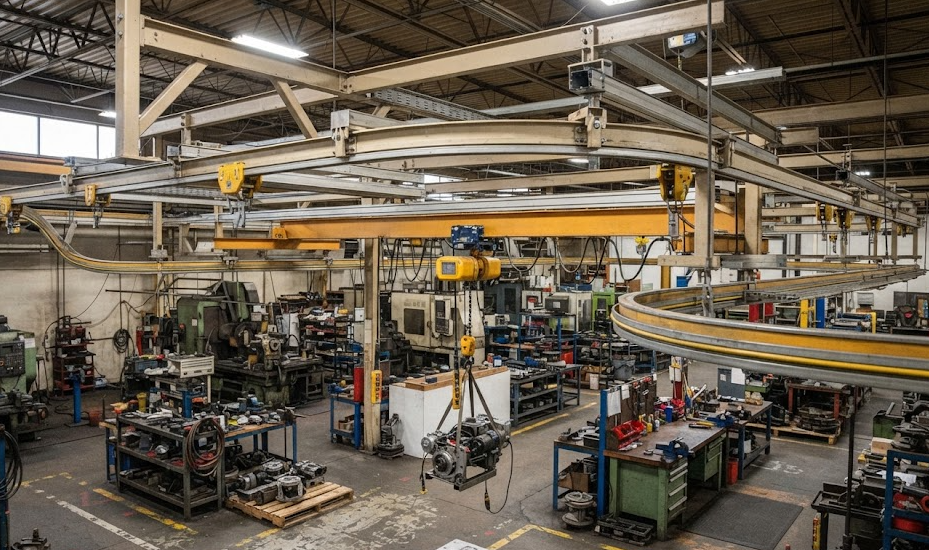
A custom light overhead crane can also move loads above the production floor. This means factories may not need as many floor-based handling tools in areas where space is already limited.
Saving Valuable Floor Space
Factory floor space has to accommodate much more than production equipment. Machines, workbenches, storage areas, forklifts, workers, and transportation routes all compete for available room.
Using additional carts or other ground-level handling equipment can make busy workshops harder to organize.
An overhead crane takes a different approach by using the space above the working area. Materials can travel over the floor while keeping important walking and production areas relatively open.
For smaller workshops or production areas with a crowded layout, this can be an important advantage of custom light cranes for manufacturing.
Common Applications for Custom Light Cranes
A custom light crane can be used in many different industrial environments. The exact configuration depends on the materials being handled and the layout of the facility.
Manufacturing Workshops
Production workers may need to move components, tooling, fixtures, and other parts between different areas. A light crane can provide lifting assistance close to the workstation.
Assembly Areas
Components can be moved directly to assembly stations rather than being carried manually over and over again. This can make the workflow more convenient for operators.
Machine Maintenance
Maintenance work often involves removing motors, pumps, mechanical components, and other heavy parts. A suitable light crane can provide lifting support during these operations.
Warehouses
Some warehouses need to handle smaller loads but do not want additional floor equipment taking up valuable space. An overhead system can provide another way to move these materials.
Production Cells
In compact production cells, several operations may take place within a relatively small area. A properly designed crane can help transfer components between different workstations.
The most suitable solution depends on the actual application rather than simply choosing a crane based on lifting capacity.
Why Customization Matters
Standard crane systems are suitable for many common applications, but they may not fit every factory.
A workshop may have a low ceiling, restricted lifting height, existing production equipment, or an unusual working area. The crane runway may also need to follow a particular path without interfering with other equipment.
This is where customization becomes useful.
Instead of changing the entire production area to accommodate a standard crane, a custom light crane can be designed with the existing factory conditions in mind. Load capacity, span, lifting height, travel range, installation space, and operating frequency can all be considered during the planning stage.
The result is a lifting system that is better connected to the way the factory already works.
What Should Factories Consider Before Choosing a Crane?
Before purchasing a light crane, manufacturers should first understand the actual lifting requirements.
Important factors include the maximum load weight, lifting height, required working area, travel distance, available ceiling space, and how frequently the crane will be used.
The factory layout is equally important. Existing machines, storage areas, production lines, and walking routes should all be considered so that the crane can operate without creating unnecessary obstacles.
It is also useful to think about future production needs. A crane should not only meet today's requirements but should also be practical if the factory changes its production process later.
Goldcrane's Approach to Customized Lifting
For a factory planning a new lifting system, choosing suitable equipment is only one part of the process. The crane also needs to work properly within the customer's existing production environment.
Goldcrane focuses on industrial lifting and material-handling solutions and can consider different project requirements when developing a custom light crane.
Factors such as load capacity, span, lifting height, travel distance, workshop layout, and operating conditions can be evaluated together.
This helps customers focus on what the crane actually needs to do rather than simply choosing the largest available model or the lowest-priced option.
Conclusion
Material handling does not always require a large and complicated crane system. For many routine lifting tasks, a custom light crane can provide a practical way to move components, tools, and machine parts around a factory.
By using overhead space, the system can also help reduce dependence on floor-based handling equipment and make better use of limited workshop space.
The key is to select a crane based on the real working conditions. Load weight, lifting height, travel distance, factory layout, operating frequency, and future requirements should all be considered before making a decision.
With customized lifting solutions, Goldcrane helps manufacturers develop material-handling systems that fit their production environment and make everyday lifting and movement easier.