As industries around the world look for more efficient and flexible ways to generate power, Circulating Fluidized Bed (CFB) boiler technology continues to play an important role in large-scale energy and industrial projects.
Power plants and manufacturing facilities are under increasing pressure to improve energy efficiency while controlling emissions and operating costs. At the same time, many facilities need boilers that can handle different types of fuel rather than relying on one fixed coal specification.
This has created growing interest in a high efficiency coal CFB boiler factory that can provide reliable equipment while adapting the boiler design to the actual operating conditions. Hailu Heavy Industry focuses on this combination of efficiency, durability, and customized engineering for industrial boiler applications.
Why CFB Technology Is Suitable for Industrial Boilers
A CFB boiler works by suspending fuel and bed materials in an upward flow of air. The circulating particles create strong turbulence inside the furnace, allowing heat to move efficiently between the combustion materials and heating surfaces.
Compared with some conventional coal-fired boiler systems, CFB technology has an important advantage in fuel flexibility. It can be designed to burn different grades of coal and can also accommodate certain biomass co-firing applications.
Another benefit is that sulfur control can be integrated directly into the combustion process. Limestone can be introduced into the furnace to capture sulfur during combustion, helping reduce the amount of sulfur dioxide that leaves the boiler.
However, simply choosing CFB technology does not automatically guarantee high efficiency. The entire circulation system, air supply, combustion process, heat transfer surfaces, and control strategy need to work together.
How Boiler Design Affects Efficiency
One of the key factors in CFB boiler performance is the circulation of solid particles inside the system.
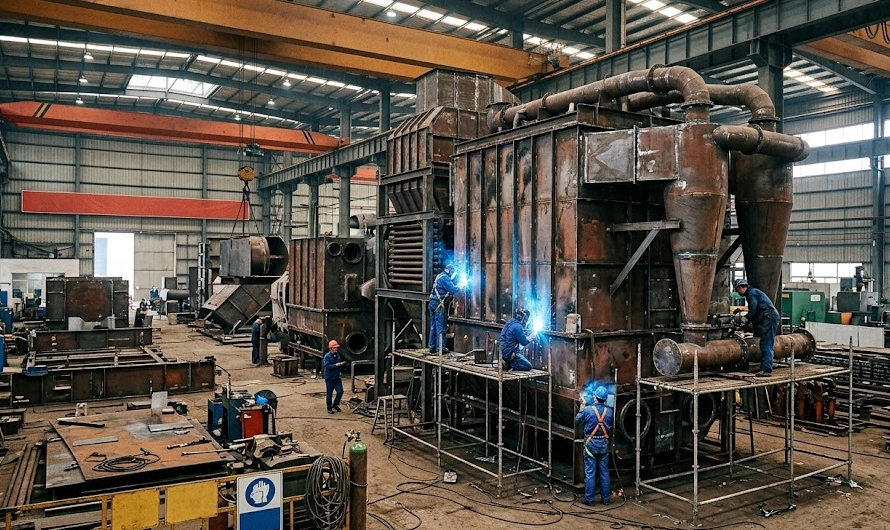
The cyclone separator plays an important role by separating solid particles from the flue gas and returning them to the furnace. Proper cyclone design can improve the circulation of bed materials while helping control pressure losses.
Hailu Heavy Industry uses engineering analysis and computational fluid dynamics (CFD) during the design process to study gas and particle movement. This allows the boiler structure and circulation system to be adjusted according to the intended operating conditions.
Reducing unnecessary pressure loss is also important because fans and other auxiliary equipment consume electricity. A well-designed system can help reduce these additional power requirements and improve the overall energy performance of the plant.
What Makes a High Efficiency Coal CFB Boiler Factory Different?
Choosing a boiler supplier is not only about purchasing a piece of equipment. For a large industrial project, the manufacturer's engineering capability, production quality, material selection, and after-sales support can all influence long-term operation.
Hailu Heavy Industry focuses on several areas when developing CFB boiler systems.
Better Heat Transfer
The heating surfaces inside a CFB boiler operate under high temperatures and demanding conditions. Proper selection of materials and heat-transfer surface design can help the boiler operate with higher steam parameters.
Higher steam pressure and temperature can improve the efficiency of the steam cycle, provided that the complete power-generation system is designed to support these conditions.
Flexible Fuel Options
Fuel quality can vary significantly between regions and projects. Some plants may have access to high-ash coal, while others may use lignite or combine coal with biomass.
CFB technology is well suited to this type of fuel flexibility. Hailu can adjust combustion and feeding systems according to the characteristics of the fuel available at the project site.
This is particularly valuable for facilities that do not want their boiler performance to depend on one specific coal source.
Controlling Wear and Extending Service Life
A CFB furnace contains a large amount of moving solid material. Over long operating periods, high-speed particles can cause wear on furnace walls and other heating surfaces.
For this reason, wear protection is an important part of CFB boiler engineering. Hailu Heavy Industry applies suitable hard-facing and membrane-wall protection methods to areas exposed to higher levels of erosion.
Effective wear management can reduce maintenance requirements and help improve equipment availability over the operating life of the boiler.
Why Custom Boiler Design Matters
Every industrial power project has different requirements. Two plants may use similar coal but have completely different steam demands, operating schedules, environmental requirements, and installation conditions.
For this reason, purchasing a standard boiler without considering the actual project conditions may not always provide the best long-term result.
Hailu Heavy Industry approaches each project according to its specific requirements. The design process can take into account factors such as:
- Fuel type and calorific value
- Ash content and fuel characteristics
- Required steam capacity
- Operating pressure and temperature
- Local environmental requirements
- Existing plant conditions
- Space and installation limitations
- Expected operating schedule
For an existing facility, the solution may involve upgrading or replacing an existing boiler system. For a new industrial plant, the boiler can be designed as part of a complete power-generation system from the beginning.
Intelligent Control for More Stable Operation
Modern boiler systems rely heavily on automatic control to maintain stable combustion and steam production.
A CFB boiler can be integrated with DCS or PLC control systems to monitor important operating parameters. These systems can help operators adjust fuel feeding, combustion air, and other operating conditions according to changes in load.
When fuel quality or power demand changes, automatic control can help the boiler respond more quickly and maintain more stable operation.
The purpose is not simply to automate the boiler. It is to help operators maintain the desired operating conditions while reducing unnecessary energy consumption and improving overall plant reliability.
Environmental Advantages of CFB Boilers
Environmental performance has become an important consideration when selecting industrial boiler equipment.
CFB technology provides several useful options for controlling emissions during combustion. Limestone injection, for example, can help capture sulfur inside the furnace and reduce sulfur dioxide emissions.
This approach can reduce the dependence on additional downstream desulfurization equipment in certain applications. The actual configuration will depend on local emission standards, fuel properties, and project requirements.
For industrial users that need to balance coal utilization with stricter environmental regulations, a properly designed CFB boiler can provide a practical solution.
Where Can CFB Boilers Be Used?
CFB boilers are suitable for a wide range of industrial and energy applications.
They can be considered for:
- Utility power plants
- Industrial power stations
- Chemical plants
- Mining operations
- Metallurgical facilities
- Manufacturing plants
- Cogeneration projects
- Facilities using coal and biomass fuels
Their fuel flexibility makes them particularly useful in locations where fuel quality varies or where alternative fuels are available.
Choosing the Right High Efficiency Coal CFB Boiler Factory
When evaluating a high efficiency coal CFB boiler factory, buyers should look beyond the initial equipment price.
Important factors include the manufacturer's engineering experience, ability to customize the boiler, material quality, combustion design, wear protection, control system integration, manufacturing capability, and technical support.
A reliable manufacturer should be able to understand the relationship between fuel characteristics, boiler capacity, steam requirements, environmental standards, and long-term operating costs.
For large industrial projects, this engineering support can be just as important as the boiler itself.
Conclusion
CFB boiler technology continues to provide an effective option for industrial users that need a combination of efficiency, fuel flexibility, and emission control.
A successful CFB boiler project depends on more than the basic boiler design. Proper fluidization, heat transfer, cyclone circulation, fuel feeding, wear protection, automatic control, and environmental measures all contribute to long-term performance.
As a high efficiency coal CFB boiler factory, Hailu Heavy Industry combines boiler manufacturing with project-specific engineering to develop solutions based on actual operating conditions. Whether the project involves a new industrial power plant or an existing facility requiring an upgrade, customized CFB technology can help users achieve more stable operation, better fuel flexibility, and improved energy performance.
https://www.hailu-boiler.com/blog/inside-hailu-s-next-generation-cfb-boiler-factories.html