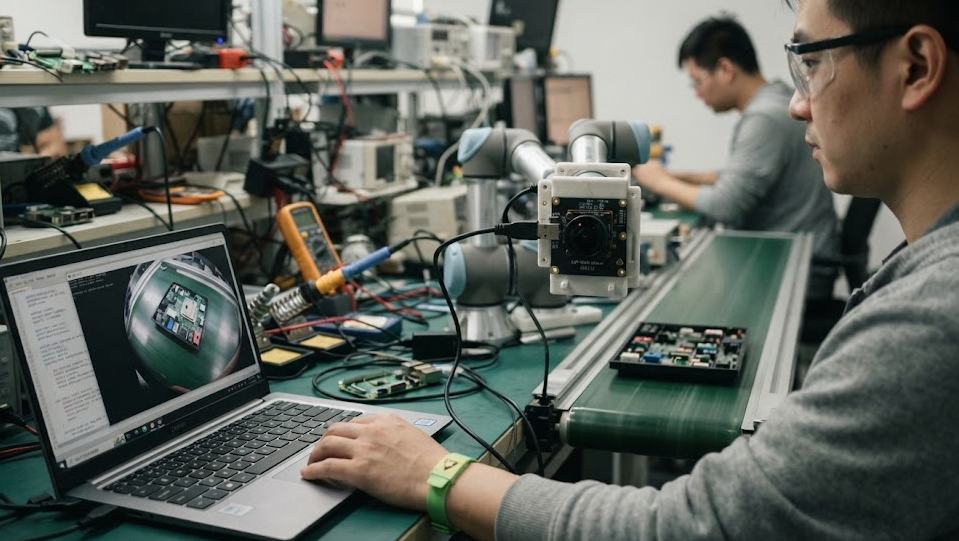
For robotics, autonomous drones, industrial inspection, and other high-speed applications, a camera needs to do more than simply produce clear images. When an object moves quickly, even a small delay between image rows can create unwanted distortion. This is one of the main limitations of conventional rolling shutter cameras.
The ELP Global Shutter USB 3.0 Camera Module Fisheye High Speed 1080P 120FPS 720P 200FPS AR0234 Raspberry Pi Webcam for Robot Drone is designed for applications where accurate motion capture and fast image transmission are important. With a global shutter sensor, USB 3.0 interface, high frame rates, and an ultra-wide fisheye lens, the module provides a practical imaging solution for embedded vision projects.
Global Shutter Technology with the AR0234 Sensor
The camera module uses the AR0234 global shutter sensor, which is designed to capture the image at the same moment across the pixel array.
This is different from a rolling shutter sensor, which reads different image rows at slightly different times. When a moving object is captured by a rolling shutter camera, its shape may appear tilted, stretched, or otherwise distorted.
Global shutter technology helps reduce these problems and is especially useful for:
- Robot motion tracking
- Autonomous drone navigation
- High-speed industrial inspection
- Machine vision systems
- Object recognition and tracking
- Robotics development using OpenCV or YOLO
For developers working with fast-moving targets, having more consistent frame information can make it easier for computer vision software to analyze the scene.
High-Speed Video Through USB 3.0
A high frame rate is only useful when the camera can transfer image data quickly enough. The USB 3.0 camera module is designed for high-speed video transmission and uses a 20-pin interface.
Depending on the selected resolution and application requirements, the camera can support several high-speed operating modes, including 1080P at 120FPS and 720P at 200FPS. These frame rates can be useful when developers need to observe rapid movements or collect more detailed motion data.
The camera also supports UVC (USB Video Class), which allows it to work as a plug-and-play device on many common systems without requiring a dedicated camera driver.
This makes the module convenient for development projects involving:
- Windows
- Linux
- Ubuntu
- Android
- Mac OS
- Raspberry Pi and other embedded platforms
For robot and drone developers, this compatibility can simplify the process of connecting the camera to an existing development system.
200° Fisheye Lens for a Wider View
A wide field of view can be valuable when a camera is installed on a mobile robot or drone. A standard lens may leave areas outside the viewing range, while an ultra-wide fisheye lens can cover a much larger area with a single camera.
The ELP module is available with a 200° ultra-wide fisheye lens, making it suitable for applications where broad scene coverage is required.
For example, a robot can use a wide-angle camera to monitor more of its surroundings, while a drone can obtain a broader view during navigation. In some designs, this may reduce the number of cameras needed and help save installation space, weight, and system resources.
Because fisheye lenses naturally produce curved images near the edges, developers can also use camera calibration and image-processing software to correct the distortion. Tools such as OpenCV provide functions for camera calibration and image remapping, which can help prepare the video for applications such as navigation and SLAM.
Why It Fits Embedded Vision Projects
One of the main advantages of this ELP Global Shutter USB 3.0 Camera Module is the combination of several features in a compact camera platform.
The global shutter helps capture fast-moving objects more consistently. USB 3.0 provides the bandwidth needed for high-frame-rate video. UVC support makes system integration easier, while the 200° fisheye lens provides a broad field of view.
Together, these features make the module suitable for developers building robot vision systems, autonomous drones, industrial automation equipment, and other embedded computer vision solutions.
What Should Buyers Consider?
When selecting a camera module for a robotics or industrial project, frame rate alone should not be the deciding factor. Buyers should also consider the sensor type, resolution, lens angle, interface, operating system compatibility, mounting requirements, and the actual environment where the camera will be used.
For high-speed applications, global shutter technology can be particularly important because it helps avoid the motion distortion commonly associated with rolling shutter cameras.
For applications that require a wide viewing area, the 200° fisheye lens is another feature worth considering. Meanwhile, USB 3.0 and UVC support can make integration with existing computers and embedded platforms more convenient.
FAQ
1. What is the difference between a global shutter and a rolling shutter?
A rolling shutter captures different rows of pixels at slightly different times, which can cause distortion when the subject moves quickly. A global shutter captures the image across the pixel array at the same time, helping reduce this type of motion distortion.
2. Can the ELP camera work with Linux and Ubuntu?
Yes. The camera supports standard UVC operation, allowing it to be used with systems such as Linux and Ubuntu without requiring a specialized camera driver in typical setups.
3. Is the 200° fisheye image distortion correctable?
Yes. Developers can use camera calibration methods and computer vision libraries such as OpenCV to calculate distortion parameters and remap the image for applications that require a corrected view.
4. What applications can use this camera module?
The module can be used in robotics, drone vision, machine vision, industrial automation, autonomous navigation, motion tracking, and other projects that require high-speed image capture and a wide field of view.
Conclusion
For embedded vision applications, choosing the right camera means considering how the camera will perform under actual operating conditions. The ELP Global Shutter USB 3.0 Camera Module combines the AR0234 global shutter sensor, high-speed video capability, UVC compatibility, and a 200° fisheye lens to address several common requirements in robotics and machine vision.
Whether it is being used as a Raspberry Pi webcam for robot drone projects, a high-speed inspection camera, or part of an autonomous vision system, this camera module provides a flexible option for developers working with fast-moving scenes and wide-area image capture.